
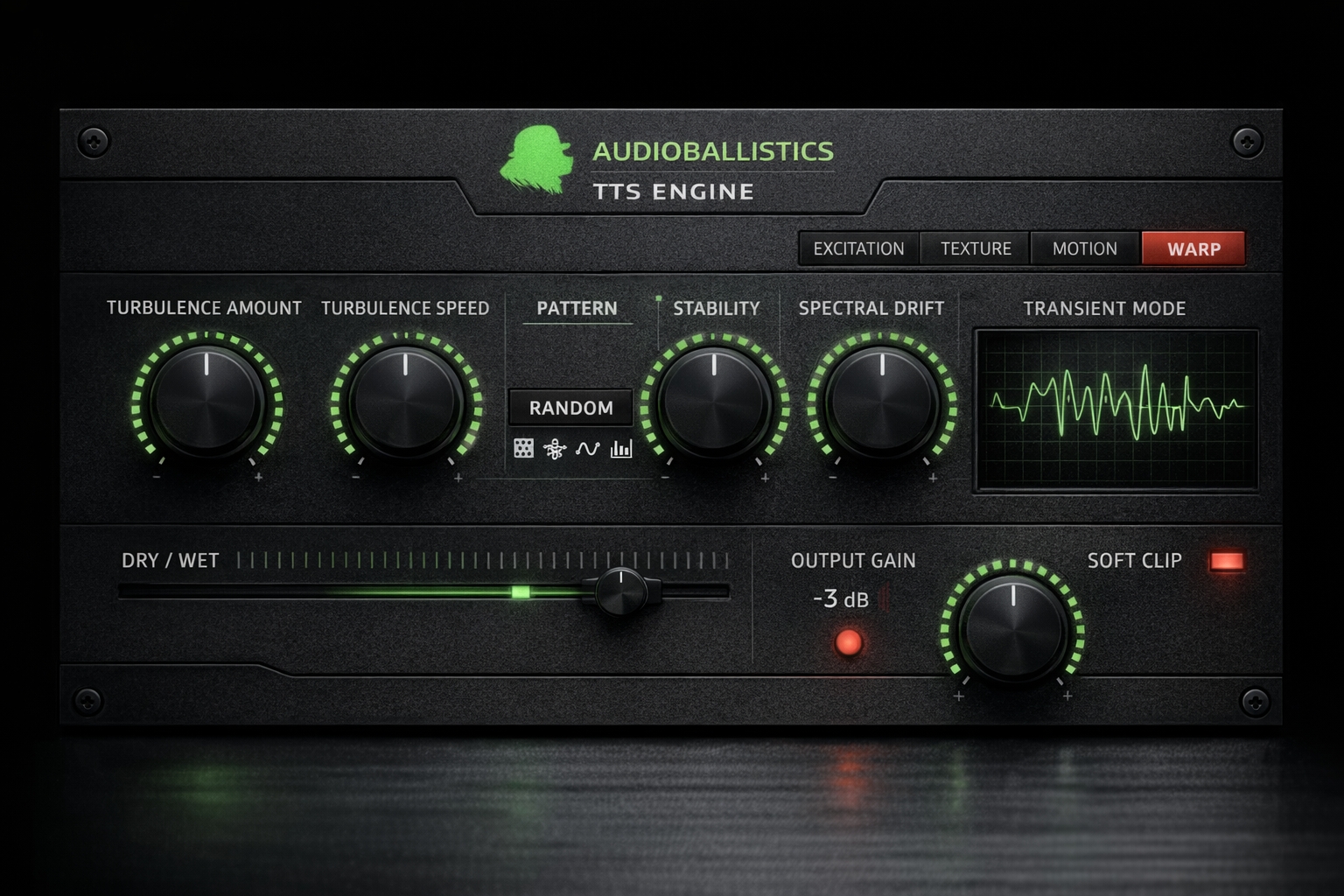
NB. This white-paper was created in conjunction with Microsoft Copilot based on a DSP concept by Audioballistics. If you’re a capable DSP coder and want to help build this engine, get in touch.
Audioballistics TTS Engine — White Paper Preface
1. Origin
Temporal Turbulence Synthesis (TTS) began as a playful experiment inside Ableton — a curiosity about how acceleration and deceleration could shape sound beyond pitch or amplitude. What started as a modulation exercise evolved into a philosophy: sound as kinetic motion, not static vibration. The Audioballistics ethos — lineage, temperament, and engineering culture — guided the transformation from DAW experiment to DSP concept.
2. Conceptual Leap
TTS reframes time not as a fixed axis but as a fluid medium. By warping playback velocity in bursts, it introduces turbulence into the temporal domain, creating spectral drift and motion that feels organic, tactile, and alive. The technique bridges psychoacoustics and engineering, merging the intuition of performance with the precision of DSP.
3. Design Evolution
The first design sketches defined the TTS Engine as a modular system:
Time‑Warp Generator — the heart of turbulence
Stability Module — the musical governor
Resampling Engine — the physics layer
Spectral Drift Module — the shimmer and character
Output Conditioning — the polish and control
From these modules emerged a plugin architecture, then a hardware vision. Each iteration refined the balance between control and chaos, between laboratory precision and musical expressiveness.
4. Visual Identity
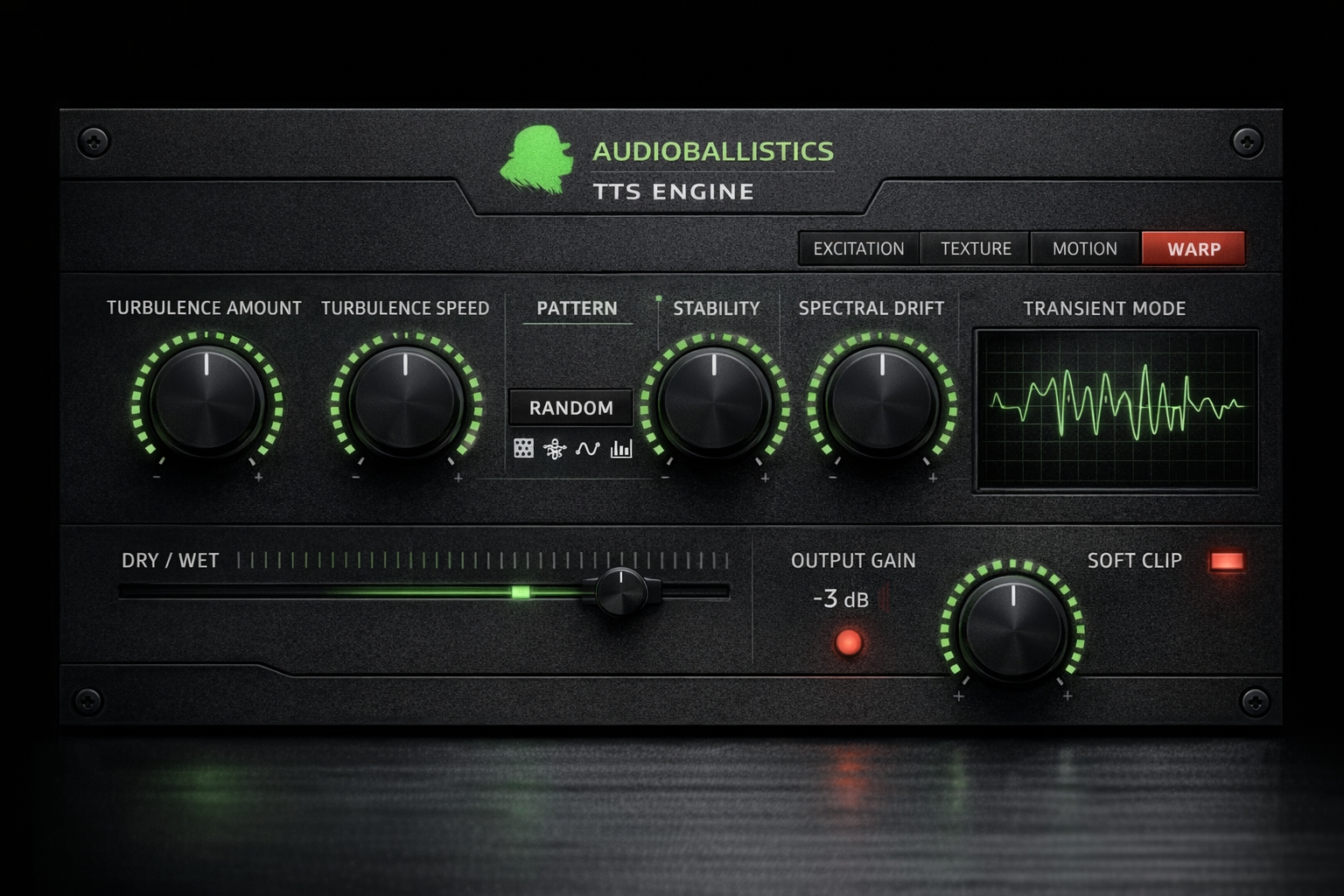
The Audioballistics design language — Wildcard Green, Clubhouse Black, and Signal Red — became the visual signature. The bowler‑hat silhouette logo anchors the instrument in heritage and wit, a nod to British engineering culture and creative eccentricity. The interface glows with kinetic intent: green for motion, red for energy, black for focus.
5. Hardware Realisation
The hardware render marks the culmination of the concept: a 1U rackmount unit with tactile knobs, toggle switches, and a live time‑warp display. It embodies the Audioballistics principle of artifact lineage — every design decision rooted in engineering temperament, not trend.
6. Philosophical Context
TTS is not merely a DSP technique; it’s a creative protocol. It invites artists to think of time as a sculptable material, to perceive sound as ‘turbulence’ rather than tone. It stands as a bridge between analogue intuition and digital precision,
7. Next Steps
The White Paper will expand on:
Mathematical foundations of temporal turbulence (conceptual)
Implementation pathways for DSP engineers
Psychoacoustic implications and perceptual mapping
Integration into the Audioballistics ecosystem
WHITE PAPER: Temporal Turbulence Synthesis (TTS)
A Non‑Linear, Time‑Varying Resampling Technique for Dynamic Excitation and Kinetic Audio Processing
Abstract
Temporal Turbulence Synthesis (TTS) is a novel DSP technique developed within the Audioballistics research and audio engineering framework. TTS operates by continuously accelerating and decelerating an audio signal during capture or playback, producing a non‑stationary excitation signal characterized by micro‑scale temporal fluctuations, spectral drift, and phase instability. Unlike traditional time‑stretching or pitch‑shifting, TTS manipulates the temporal velocity of the input signal in real time, generating a dynamically warped waveform with unique psychoacoustic and analytical properties. This paper defines the technique, situates it within the broader DSP landscape, and outlines potential applications in sound design, calibration, and temporal‑domain audio enhancement.
1. Introduction
Digital Signal Processing (DSP) has historically focused on stationary or quasi‑stationary signals, where spectral and temporal properties remain stable over time. Techniques such as filtering, convolution, granular synthesis, and phase vocoding operate under assumptions of predictable behaviour.
Temporal Turbulence Synthesis challenges this paradigm by introducing controlled temporal instability. Instead of processing audio through static or periodic transformations, TTS modulates the velocity of the signal itself, creating a form of temporal turbulence that yields complex, evolving sonic characteristics.
2. Background and Lineage
TTS draws conceptual lineage from:
Analog time‑domain manipulation (tape varispeed, wow & flutter)
Granular synthesis (micro‑time segmentation)
Phase vocoding (time‑frequency warping)
Non‑stationary signal analysis (seismic, radar, biomedical DSP)
Excitation signal design (pink noise, chirps, MLS signals)
However, TTS is distinct in that it:
– modulates input velocity, not output playback
– produces non‑repeating temporal structures
– generates wideband, dynamic excitation
– creates phase‑unstable micro‑transients
– yields kinetic sonic behaviour
This positions TTS as a new DSP category.
3. Formal Definition
Temporal Turbulence Synthesis (TTS) is a non‑linear, time‑varying resampling technique in which an audio signal is continuously accelerated and decelerated during capture or playback, producing a non‑stationary excitation signal characterized by micro‑scale temporal fluctuations, spectral drift, and phase instability.
Unlike traditional time‑stretching or pitch‑shifting, TTS operates on the input signal in real time, creating a dynamically warped temporal structure that cannot be reproduced by static DSP processes.
Mathematical Model (Conceptual Description)
Temporal Turbulence Synthesis operates by subtly disturbing the flow of time within an audio signal. Instead of processing the sound through filters or modulation blocks, TTS alters the perceived temporal behaviour of the waveform itself.
The signal experiences:
- micro‑accelerations and slowdowns
- non‑periodic fluctuations
- continuously shifting temporal pressure
- gentle instability in the time domain
This turbulence manifests as:
– spectral drift
– transient smearing
– harmonic instability
– wideband excitation
5. Applications
5.1 Sound Design
– evolving pads
– kinetic textures
– cinematic atmospheres
– glitch‑style transitions
– “living” harmonic motion
5.2 Calibration & Testing
– speaker burn‑in
– headphone driver excitation
– resonance detection
– room excitation
– psychoacoustic testing
5.3 Creative Processing
– temporal shimmer
– micro‑movement
– dynamic spectral enhancement
– transient energising
6. Comparison to Existing DSP Techniques
TTS is not:
– granular synthesis
– pitch shifting
– time stretching
– modulation
– convolution
It is closest to:
– non‑stationary resampling
– temporal warping
– dynamic excitation
But remains distinct due to its continuous, real‑time velocity modulation.
7. Implementation Considerations
A TTS processor requires:
– a time‑warp generator
– a resampling engine
– a stability control system
– optional spectral smoothing
– optional transient preservation
Modes could include:
– random turbulence
– patterned turbulence
– envelope‑driven turbulence
– audio‑reactive turbulence
8. Conclusion
Temporal Turbulence Synthesis represents a new class of time‑domain DSP. Its ability to generate non‑stationary, wideband, kinetic audio signals opens new possibilities in sound design, calibration, and psychoacoustic processing.
Leave a Reply